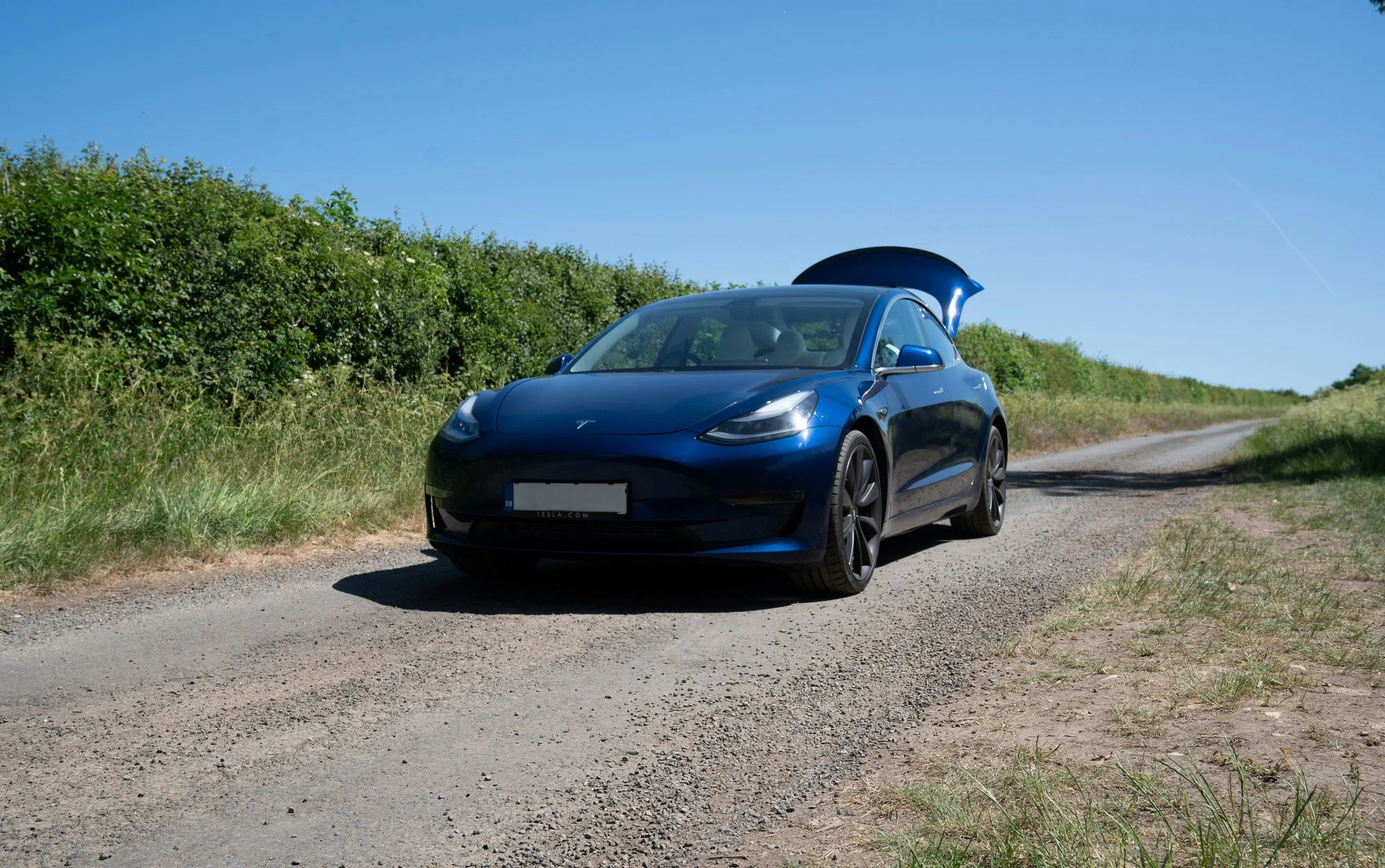
It was raining in Pembrokeshire, the sideways sort of rain that Wales keeps for people who have just put a tent up. Everyone was asleep except the dog, who was standing at the tent door making it clear that the arrangement wasn't acceptable. So at about eleven o'clock the dog and I went and slept in the Model 3, with Camp Mode holding the cabin at 19°C, while the tent flapped about thirty feet away.
We camp a few times a year, mostly in Wales, Devon, Cornwall and along the south coast, and we've done it with the Model 3 since 2019. People ask whether you can take an electric car on a camping holiday. You can, and for us it hasn't made camping any harder, once we stopped expecting the campsite to fill the battery. This is how we do it, and what changes when the Model Y arrives in February.
Packing a saloon for four people and a dog
We take two cars, because a family tent and a camping kitchen will not go in one car with the people as well. The Model 3 takes the four of us, the dog and the bags. This summer the Discovery Sport took the tent and anything likely to get muddy, on what turned out to be its last camping trip before we sold it. Next summer, for the first time, both cars will be Teslas.
The frunk is the most useful space for camping. Ours takes the wellies and waterproofs, so nothing wet comes into the cabin. The bags go in the boot. The dog travels on a blanket in the middle of the back seat, clipped in between the boys and supervising.
A roof box on Tesla's roof rack carries the bulky, light things. Tesla's roof rack manual gives a 65 kg maximum, and that includes the weight of the rack and the box itself, so it's for duvets and camping chairs, not tins of beans. The box costs range at motorway speeds, somewhere around a tenth on our car by my reckoning. We take it off as soon as we're home, mostly so I stop hearing it on the school run.
The list that lives on the fridge door before every trip:
- Tesla's Mobile Connector (the granny cable) in the frunk
- A proper tent hook-up unit with its own RCD
- Wellies and waterproofs in the frunk, not the boot
- The dog's bed, lead and towel
- A low-wattage camping kettle
- The car charged to 90% the night before, on the cheap overnight rate
Charging on the way down
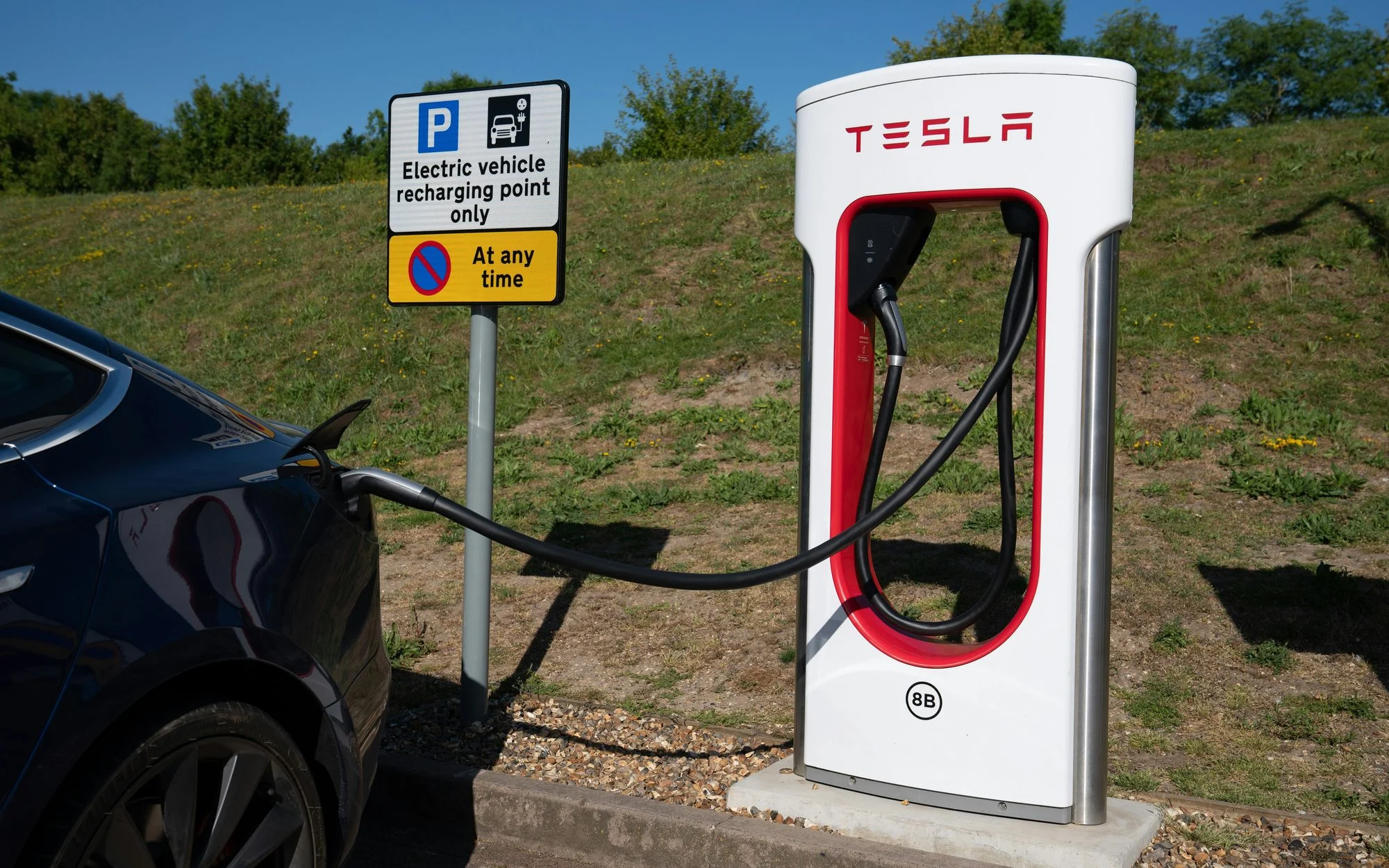
The Model 3 could probably reach Cornwall from home in one go in summer, but not with much to spare once the roof box is on, and the boys can't manage that far without a stop anyway. On the way to Devon and Cornwall we usually charge at Gordano services on the M5, just past Bristol, or at Exeter, where the Sandygate Supercharger has 32 stalls (as of October 2026, Tesla). In Cornwall there are Superchargers at Kingsley Village near Newquay and at Camborne, with 8 stalls each (as of October 2026). For west Wales, Carmarthen has 12 stalls at the St Catherine's Walk shopping centre (Tesla, as of October 2026).
Our rule is to arrive at the campsite with more than half a battery and top up near the site on a day out or on the way home. The only queue we've met in Devon was on an August bank holiday, and to be fair to the Supercharger, there was also a queue for the toilets and the pasties.
What a campsite hook-up can and can't do
A pitch with electric hook-up is there to power a caravan or a tent, and the car is a guest.
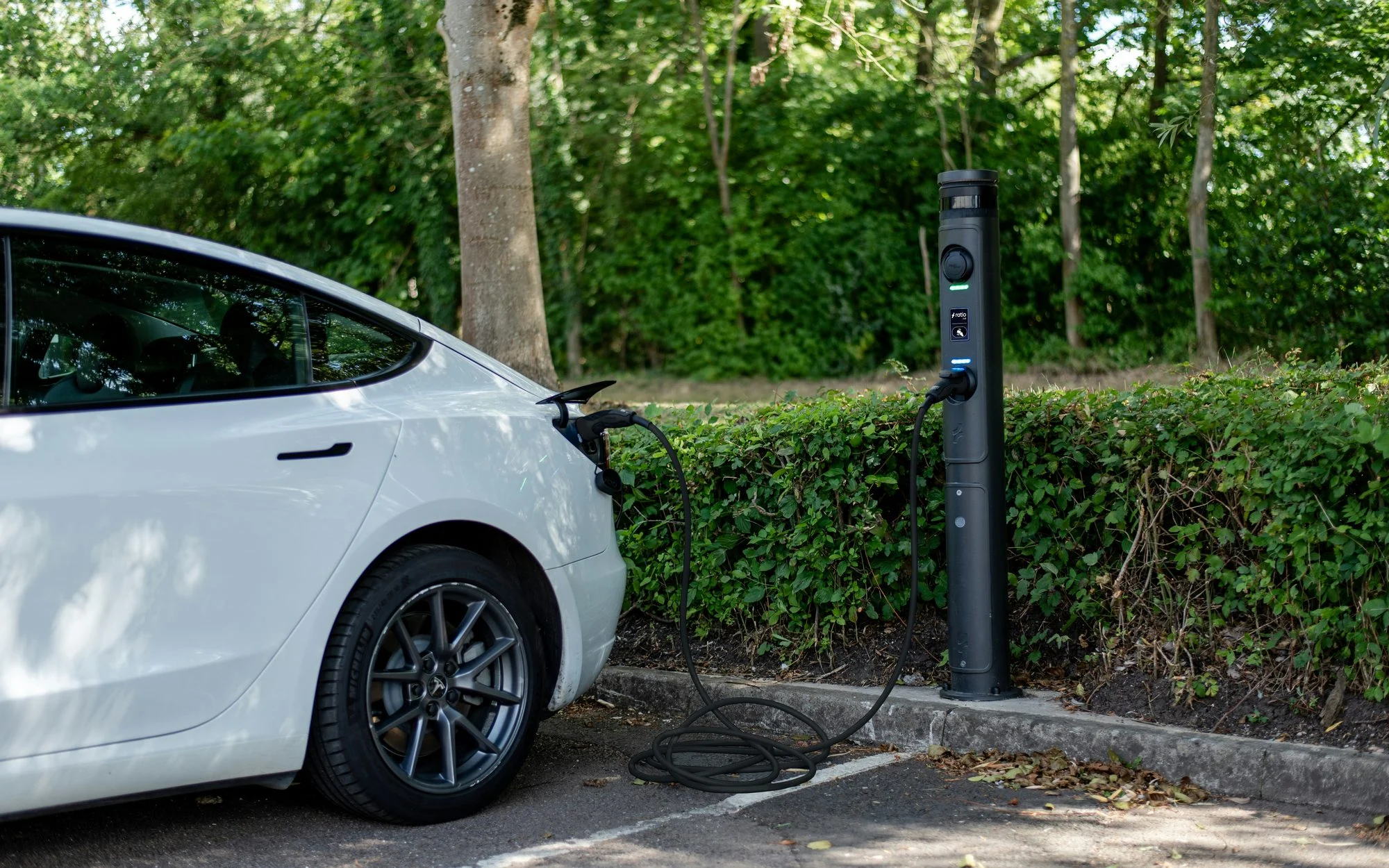
Most Camping and Caravanning Club sites supply 16 amps per pitch, and some only 10 amps (Camping and Caravanning Club, checked October 2026). At 16 amps that's about 3.7 kW for everything on the pitch. Tesla's Mobile Connector on a UK three-pin plug charges at 10 amps, about 2.3 kW (Tesla, as of October 2026), which leaves roughly 1.4 kW for the kettle and everything else. A normal kitchen kettle needs more than that. We learnt this the way most people do, with a click from the bollard and everything going dark just as my partner wanted a cup of tea. Now we have a camping kettle and the car charges overnight, when nobody wants tea.
Both big clubs allow it, with rules. The Camping and Caravanning Club says you must charge through your own unit, never by plugging straight into the bollard, and that at busy times you need the site's permission first (Club Site Policies, checked October 2026). The Caravan and Motorhome Club charges £7 a day, asks you to plug the car into a socket in your outfit with a Mode 2 cable rather than into the bollard, and puts the limit at 2.3 kW (Caravan and Motorhome Club, checked October 2026). Independent campsites set their own rules, and plenty don't allow it at all, so we ask when we book.
Tesla's Mobile Connector manual says not to use an extension lead with it (Tesla), and a long hook-up cable to a tent unit is close to one, so we treat the hook-up as a gentle top-up and not the plan. Our Mobile Connector came with the car in 2019. Tesla no longer includes one with new cars. A night on the hook-up gives us something like 70 or 80 miles back, which is plenty for a day of driving between beaches that the boys then rate out of ten.
A night in the car with Camp Mode
Back to Pembrokeshire, and the dog. Camp Mode is Tesla's setting for staying in the car while it's parked. It keeps the cabin at the temperature you choose with the air moving, keeps the USB ports and the 12V socket powered, and leaves the touchscreen on for music or a film. The alarm and Sentry Mode are off while it's running. It won't run in Low Power Mode, and Tesla advises against using it when the battery is low (Tesla Model 3 owner's manual, as of October 2026). It's in the climate controls, or the app.
With the rear seats folded and a camping mat over them, the Model 3 makes a bed that's long enough for me if I lie at a slight angle with my feet in the boot. It isn't flat or spacious, but the rain stayed outside and the dog slept better than anyone in the tent. Overnight it used about a tenth of the battery, on a mild, wet Welsh night.
The boys now ask to sleep in the car on every trip. My partner pointed out that they have never once volunteered to sleep anywhere smaller than their own bedrooms.
Why the Model Y is going camping next year
Camping was a large part of why we chose the Model Y. Tesla's newest Model Y has 2,138 litres of luggage space with the rear seats folded, counting the frunk (DrivingElectric, April 2025). It's a hatchback with one big opening instead of a saloon boot lid, and it's taller inside, which matters when you're sitting up in a sleeping bag. The seats still don't fold completely flat, so the camping mat is coming with us. We're also having a tow bar fitted for a bike rack once the car is registered, for tax reasons I explained in how we're paying for our Model Y.
If you're choosing an electric car for camping, I'd put the Model Y near the top of the list for the space alone. You can build a Model Y in Tesla's design studio(referral link) through our referral link and see the price for your spec before you commit to anything.
Before your first trip
Camping with an electric car is easy as long as you treat the campsite hook-up as a bonus. Charge at home, and ask the campsite before you plug anything in. If someone in your family has views on tents, Camp Mode makes for a comfortable night in the car, and in a Model 3 a cosy one.
If this would be your first Tesla, ordering a new Model 3 or Model Y through our referral link(referral link) gets you 650 free Supercharging miles (as of October 2026). That's roughly one and a half return trips from the Cotswolds to Cornwall, with the roof box on.